
4.0 stars. An interesting premise but overly simplistic and not written very well.
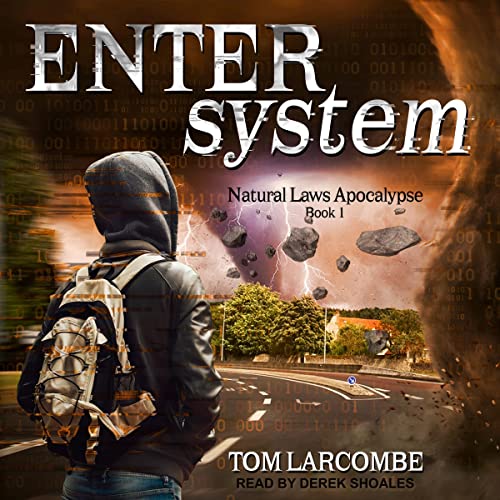
The Natural Laws books is one of the purest examples of LitRPG. Everyone in the world gets a message in their head about the impending system that is being installed on Earth in 3 days. Marc spends the three days training – working out, reading the manual and making plans with his friends once this new system goes into effect. Smart.
And then once the system goes online, they quickly establish a safe zone at a school – a place where monsters will not spawn inside. Also smart. Marc and his friends work hard to expand the safe zone, and it gets bigger and bigger. And pretty soon, a happy little town has been established as people flock to live inside the safe zone.
So far, so good. The series starts well.
One of the clever plot elements early on in this book series involves the Main Character constantly filing bug reports with the system to fix the help manuals. He spends a lot of time in the first book trying to improve the English, fix the grammar, and improve the manual. (Then we never hear about him fixing the system help files again, except when he’s bragging to others how he once fixed the system help files. Just one of the interesting ideas that gets completely abandoned by the author.)
This leads to him writing his own “guide” to how the system works for newbies, and selling it on the marketplace to make a little money. Money can be used to buy other cool things from the galaxy that can make their lives easier. But this side plot falls apart quickly, as the MC only has time to make a few copies at a time (10 or 15) and becomes too busy to make more or do this every day. It seems like a clever idea, but fizzles out as the author must have lost interest writing about that. (Another plot element dropped.)
This book has a lot of city building elements, which were nice. Marc basically decides that he needs a community kitchen, and makes one. That kitchen needs vegetables and so he uses the system to create a vegetable garden. He decides that he needs buildings to house residents, and uses the system to make it. He wants to expand his territory, and if he has the resources for it, the walls automatically move farther out. This is cool.
There’s a lot of city building in these books. A lot. I like the idea of it, but there’s a few elements that make it not as good as it could have been.
One is the ridiculous notion that building materials “fly in” from all directions to make a building or structure. You want to build a shed, and suddenly wood flies up from where it is sitting, around corners, through alleyways, and then moves in place to make the shed. Does it cut itself to the right length and shape? Do trees magically become planks? Does a car magically become nails?
The entire city becomes a danger zone the moment they decide to build something, and they do it a lot. Clever to have the child messenger dropping flags in the areas where it will be dangerous. But I expect a few people must have been killed during construction of a children’s playground or something trivial from flying car metal. You walk around a corner and boom – hit in the face with a flying tree.
Another is that nothing seems to get done without the main character to do it. He demands everyone in the city “chip in” and contribute to the running of the city, but it doesn’t seem like any decisions get made without him.
Another harmful trait is that he has no vision for the city he’s building. He sits at the menu, looking at options, and decides “Oh! I’m going to build a zoo!” Within an hour, there’s a zoo. I both love the city building aspect (and how dedicate the author is to the fine details of building a city) and feel the main character shouldn’t be doing it. As well as killing the monsters. As well as flying around meeting other city leaders establishing trade deals. As well as building a space ship. As well as manually making paper from tree pulp. As well as deciding what movies to show on movie night… He does everything and doesn’t delegate anything, even trivial stuff.
I think the author needs the MC to go away for a few months, and force the city to operate without him. Then when he returns, he’s not allowed to do the things he used to do like build new buildings or plan which crops get grown in the fields. Or make paper by hand.
The quality of the writing is my main critique. I’m on book 4 and the dialog often goes something like this:
Marc looked up from his tablet. Jeff was being a real jerk, and he needed to say something. “You’re being a real jerk right now,” Marc said. “No I’m not”, Jeff scowled. Marc made a mental note to talk to Felicia about it later. Maybe Ella knows what is going on with Jeff? Marc made another mental note to talk to her later too. Jeff stomped out of the room. Marc watched as he left. Marc shook his head in disgust mentally. He couldn’t believe Jeff did that. Then, Marc then when back to searching the system for what movie to watch with Felicia later.
OK, that’s not an actual quote from the book. But it could have been. The writing feels very undeveloped. I have almost no sense of what these characters look like, what their new safe zone looks like now that it’s developed, their personality traits, or anything much besides what people are saying and doing. Their motivations are simple.
There’s no complexity or depth here. The emotions are always so simple. No one ever seems to be sad or depressed or lost or conflicted. There’s no lingering trauma from the system being forced on Earth, no one worries about the future (when aliens can inhabit Earth), and no one is really even sad about the death of so many loved ones who didn’t make it to a safe zone in time. No one dies from monster hunts even. There’s no real bad guy or antagonist to drive the characters forward.
Side note: How many “mental notes” can you take? And what does it mean to “shake your head mentally”?
The author sometimes need to express the emotions of others besides the main character, it’s all so vague.
Marc could tell that Octavius was getting frustrated. Not that he could read any expression on the octopus’ face, but he just gave off the impression.
Like, what even IS that? I understand that it’s difficult to read emotions on the face of an octopus… but can we get a better description for that?
Things I liked about the book series:
- It’s a light read
- Everyone gets along and nothing bad ever happens
- The main characters prepared for the system and organized themselves quickly to create a safe zone and save people
- Good fight scenes
- Contains elements of city building, friendships and romance
- Some clever city building things you don’t see in other books
Things that took away from it:
- None of the characters show any personal growth
- The world is very bland with no real description of places
- There are no personalities besides “one guy is a jerk but he’s trying to get better”
- Nothing ever happens when the main character Marc is not in the room
- Everyone just accepts that the main character is just in charge of everything, everywhere
- The strongest character spends most of his time running a small city and making inconsequential decisions such as what movies get shown on movie night
- I don’t like the raccoon pet/companion
Some of these things caused me to stop reading the series for a long time after book 3. However, I have recently finished book 4 and 5, and am trying to give the series another chance. I want to like this.