
Sometimes, in book 1 of a series, the author will take time to explain how the economics of a world works in great detail.
1 Iron coin is 10 Bronze coins, 10 Bronze coins is 1 Silver coin, etc.
And then they’ll highlight the costs of things. This sword, which the MC absolutely needs, costs 4000 Gold coins! But this other one, less special, is only 1000. This gives the MC a chance to count his pennies, and worry about how he’s going to be able to afford a decent set of armor of the sword is going to use up almost all his money.
In the big city, the cost of things are this much, but in the smaller cities, they cost a bit more. Lots of detail on how the economy works.
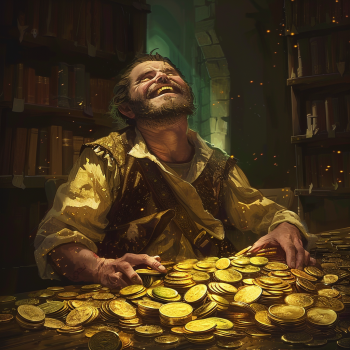
By book 3 of the series, all talk of money generally stops. The MC doesn’t worry about the costs of things – just the availability of them. And there’s no mention of how many coins he or she earns from killing each monster. The MC stops counting how much loot they have. Talking about money generally just goes away after the first book.
It’s not always true that they just hand-wave over economics. Sometimes, the MC sets up “a business” in order to make money on the side.
- In System Universe, the MC kills a special kind of beast in order to sell to the main restauranteur for money, invents a new type of beer, etc.
- In He Who Fights With Monsters, the MC develops the ability to create legitimate money out of thin air
- In The Good Guys, the MC earns money from quests just to free slaves and end up with no money
- In Sigma Worlds, the MC invents common things like a sleeping bag and a shower and patents them; partnering with a local merchant to split the profits
- In Natural Laws Apocalypse, the MC starts making some guide books to sell on the global marketplace for some extra cash.
I would say all of the above examples start off trying to answer the question – how does the MC spend all his/her time adventuring, supporting multiple other people, and expanding his territory without money? But to me, the economics make no sense.
Like in System Universe, if the MC can kill one beast and sell it for millions of coins, how does that scale when he kills 30 of the same beast? It went from being this one incredible rare thing that people haven’t seen for years, to being common. Would every rich family in the Kingdom empty their treasury to acquire one still? It would kill the market.
Or in HWFWM, if a character can create money out of thin air (with his face on it!), why do people just accept that? Would every business just trade these coins with each other without question? That would kill the market too.
In the real world, imagine if someone in your town can print Dollar Bills in their basement, and the government accepts them as legitimate! It’s ridiculous and the people would not stand for that injustice. Everyone else works 8 hours per day for $8 per hour, and one guy can print $100 on his laser printer.
And let’s say that guy is allowed to keep printing money, why wouldn’t he print a $1 billion worth of money and deposit it into the bank? Or $1 trillion? Economics are broken if anyone is allowed to just print/make/win an unlimited amount of money.
Economics is a tricky subject, even in the real world. What is the effect of inflation, interest rates, increased money supply, war spending, corruption… all of these factors play together in the real market. For a book author, it’s easier just to ignore most of that when world building. But when they just make it too easy to earn unlimited amounts of money so that the MC can ignore having to work for money, that’s not a great solution either.
I suspect the author (and the audience) got bored of talking about money. It’s much more interesting to talk about levels and skills and epic monsters and quests. They probably just lose interest in the MC counting the gold in his storage space and worrying about how they’ll afford the resources to keep the cloud house running.